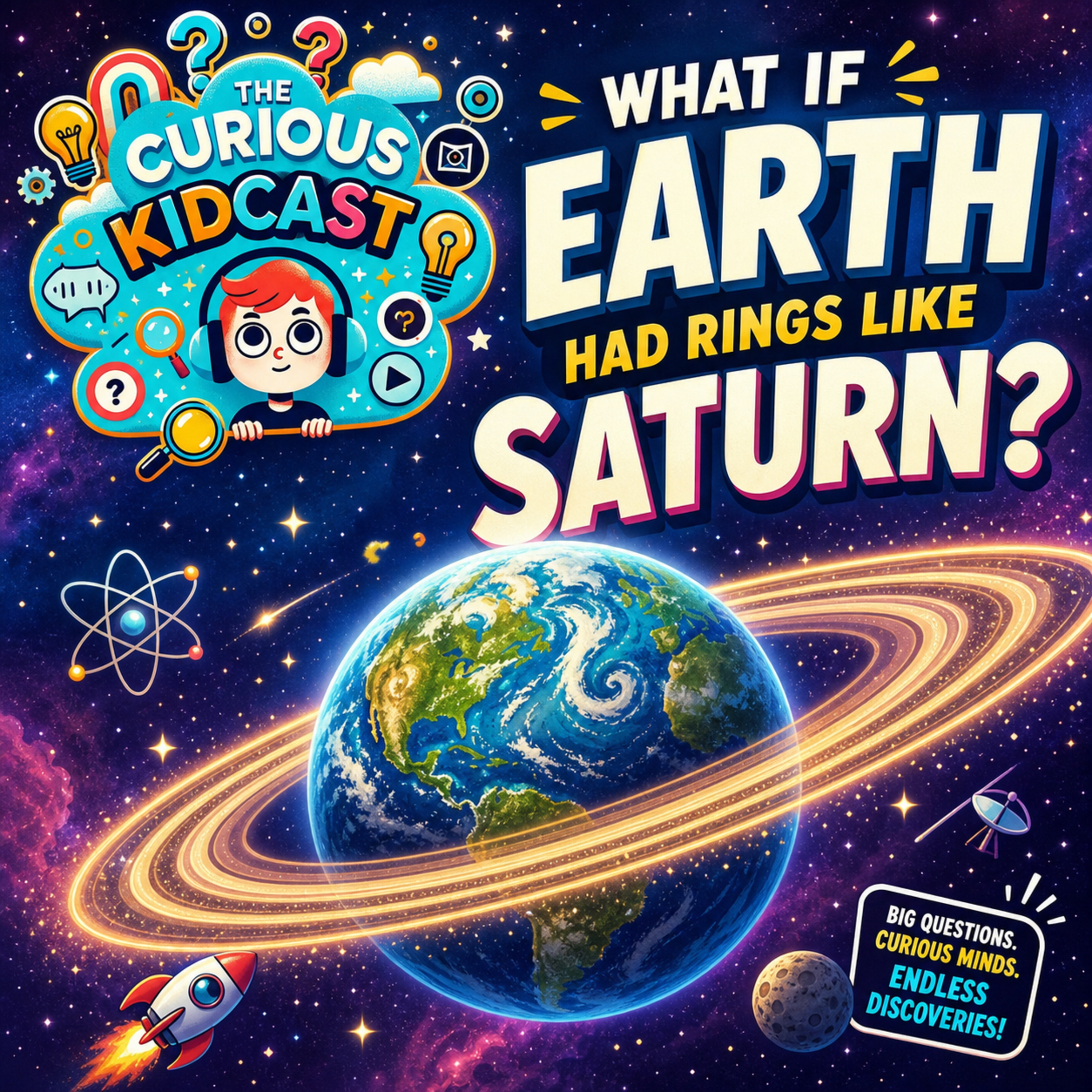
What if Earth had rings like Saturn?
Listen to this episode
What You'll Learn
- What planetary rings are and what they are really made from.
- Which planets in our Solar System have rings and why they look so different.
- How gravity shapes rings and keeps material moving through space.
- What Earth’s sky might look like if our planet had a giant ring system.
- How rings could change sunlight, shadows, night skies, and the way Earth looks from different places.
- How wildlife, habitats, and nature could be affected by changes in light and temperature.
- Why weather and climate might change if giant shadows were cast across parts of Earth.
- Why rockets, satellites, and space exploration could become much more dangerous.
- How science helps us answer huge “what if” questions in creative and surprising ways.
- Planetary rings are not solid hoops but enormous collections of ice, dust, and rock.
- Saturn is not the only planet with rings in our Solar System.
- Gravity plays an important role in shaping planets, moons, and rings.
- Rings can stretch across huge distances while staying surprisingly thin.
- Changes in light and shadow can have a big effect on natural systems.
- Space science helps us understand Earth better by imagining extreme possibilities.
Show Notes
The Curious Kidcast is a fun podcast for kids who love big questions, amazing facts, science, space, nature, and learning about the world around them. In this exciting episode, Charlie explores a fascinating space “what if” and explains how Earth, the sky, daylight, darkness, wildlife, weather, climate, and even space travel could all be affected. It is a brilliant listen for children who enjoy curious kids questions, fun science, and family-friendly learning that makes complicated ideas feel exciting and easy to understand.
If you are looking for kids curiosity podcasts, a fun podcast for kids, or a science podcast for kids that mixes real facts with imagination and fun, this episode is packed with discovery. It is ideal for curious kids aged 7 to 12, parents, teachers, and homeschoolers who want educational audio that helps children learn, laugh, and stay curious.
What kids will learn in this episode
- What planetary rings are and what they are really made from.
- Which planets in our Solar System have rings and why they look so different.
- How gravity shapes rings and keeps material moving through space.
- What Earth’s sky might look like if our planet had a giant ring system.
- How rings could change sunlight, shadows, night skies, and the way Earth looks from different places.
- How wildlife, habitats, and nature could be affected by changes in light and temperature.
- Why weather and climate might change if giant shadows were cast across parts of Earth.
- Why rockets, satellites, and space exploration could become much more dangerous.
- How science helps us answer huge “what if” questions in creative and surprising ways.
Amazing science facts for curious kids
- Planetary rings are not solid hoops but enormous collections of ice, dust, and rock.
- Saturn is not the only planet with rings in our Solar System.
- Gravity plays an important role in shaping planets, moons, and rings.
- Rings can stretch across huge distances while staying surprisingly thin.
- Changes in light and shadow can have a big effect on natural systems.
- Space science helps us understand Earth better by imagining extreme possibilities.
Perfect for families, schools, and homeschooling
This episode connects well with KS2 science topics including space, the Solar System, gravity, light, shadows, habitats, ecosystems, and scientific thinking. It is perfect for family listening, classroom use, home education, and homeschooling, helping kids learn real science facts in a fun, memorable, and engaging way.
Whether you are listening in the car, during a homeschool science session, at home after school, or as part of a family learning routine, this episode gives children a chance to explore science through curiosity, questions, and imagination. It is designed to make learning feel fun, accessible, and full of wonder.
About The Curious Kidcast
The Curious Kidcast is a family-friendly educational podcast for kids aged 7 to 12. Each episode answers curious kids questions about science, nature, animals, space, the human body, and the world around us with fun storytelling, humour, and amazing facts. It is a great choice for curious children, parents, teachers, and homeschool families looking for a fun way to learn together.
Send your question at curiouskidcast.com.
Keywords: curious kids questions, fun podcast for kids, kids curiosity podcasts, science podcast for kids, educational podcast for kids, homeschooling podcast, homeschool science podcast, family podcast, nature podcast for kids, science facts for kids, fun facts for children, kids learn about space, family learning, learn, facts, fun, family, The Curious Kidcast