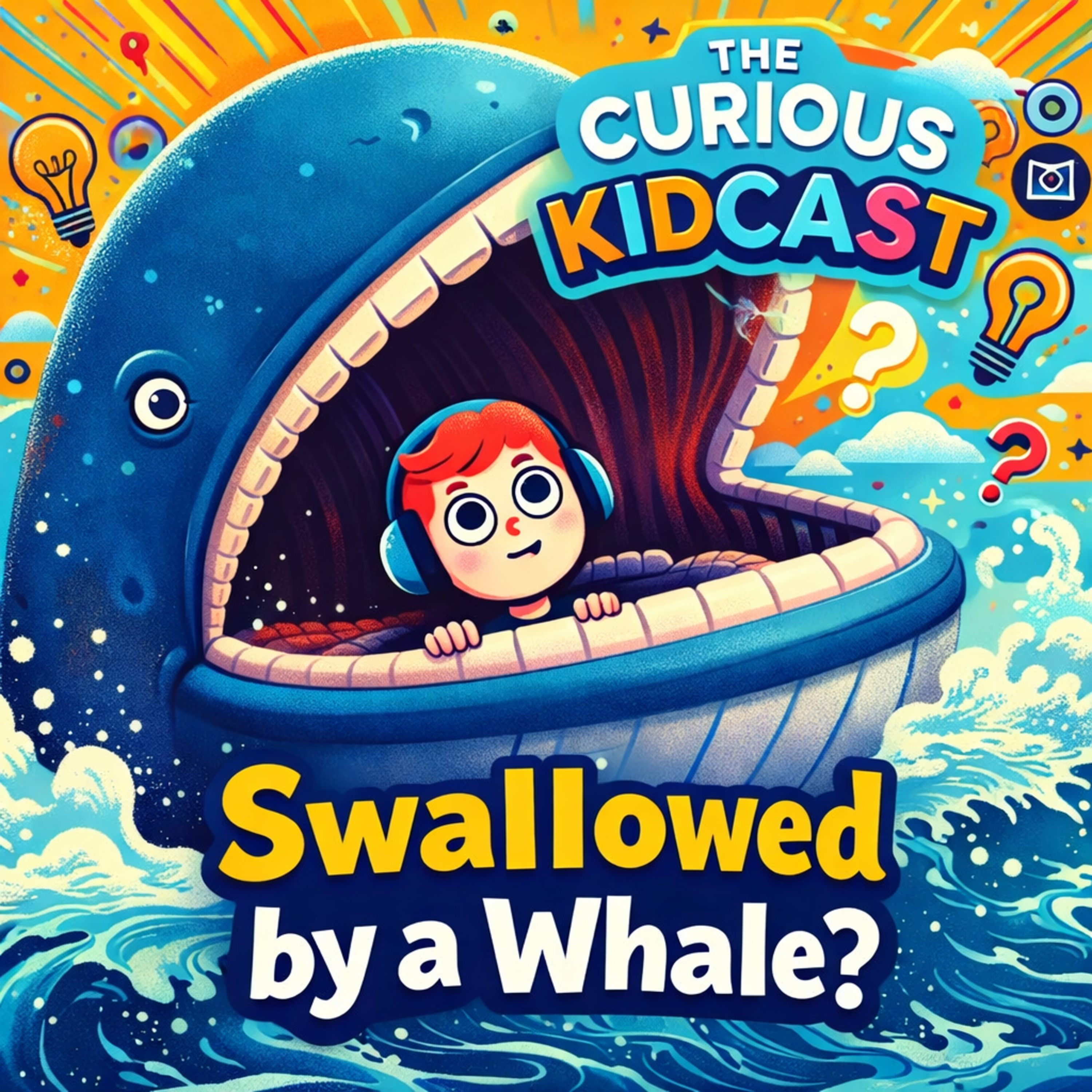
What if you were swallowed by a whale, could you survive inside?
Listen to this episode
Show Notes
What if a mouth the size of a school bus opened beneath you in the ocean and, WHOOOMP, you were inside a whale. Could you survive in there. This week Charlie dives deep into one of the wildest questions ever sent into the show, and the answers are even more surprising than you think.
About This Episode
In this episode, Charlie explores the science behind whale anatomy, finds out which whale could theoretically swallow a human and why it almost certainly never would, and investigates a famous 1891 sea legend that most historians think was made up entirely for newspaper headlines.
Along the way we discover just how staggeringly big blue whales really are, learn about the deep-sea battles between sperm whales and giant squid, and hear about the real-life lobster diver who ended up inside a whale's mouth in 2021 and lived to tell the tale. It is science, nature, history, and just a little bit of comedy all mixed together, which is exactly what The Curious Kidcast is about.
Key Facts Covered in This Episode
Blue Whale Fast Facts
- The largest animal that has ever lived on Earth, bigger than any dinosaur
- Can grow up to 30 metres long, about the same as three buses parked end to end
- Can weigh around 150 tonnes, heavier than 25 elephants
- Its tongue alone can weigh as much as an entire elephant
- Can scoop up around 70,000 litres of water in a single gulp
- Throat is only about the size of a grapefruit, because they eat tiny krill
- Filters food through comb-like structures called baleen
Sperm Whale Fast Facts
- Has a much larger throat than a blue whale, large enough for a human to technically fit through
- Can dive more than 2,000 metres below the surface, deeper than four Eiffel Towers stacked up
- Hunts squid and fish in the deep, pitch-black ocean
- Does not eat humans, we are simply not part of their diet
- Often found with round scars from giant squid suction cups after deep-sea battles
Why You Could Not Survive Inside a Whale's Stomach
- Almost no oxygen inside the stomach, you would pass out very quickly
- Powerful stomach acids designed to dissolve fish and squid
- Complete darkness, extreme warmth, and an indescribably bad smell
What Kids Will Learn
This episode is a brilliant entry point into marine biology and ocean science for curious kids. Alongside the comedy and storytelling, listeners come away understanding the difference between baleen and toothed whales, how filter feeding works, why animal size does not always equal danger, and how scientists use physical evidence like scars to learn about behaviour they cannot directly observe. For homeschooling families, this episode pairs well with topics on marine ecosystems, food chains, animal adaptation, and scientific scepticism when evaluating historical claims.
Something to Think About
At the end of the episode, Charlie poses a bonus question to think about: whales are mammals just like us, which means they need to breathe air. So how do they sleep in the ocean without drowning.
Science for Kids
Nature
Ocean
Whales
Marine Biology
Fun Facts
Family Podcast
Homeschooling
Learn
Parenting
Kids Ages 7-11
Animals
Education
Got a big, weird, wonderful question you want answered on The Curious Kidcast? Maybe something about space, animals, history, or how things work. Send it in and it could be the next episode.
You can also subscribe on all major podcast platforms so you never miss an episode.
The Curious Kidcast · curiouskidcast.com · Science, nature and fun facts for curious kids aged 7–11 · Hosted by Charlie