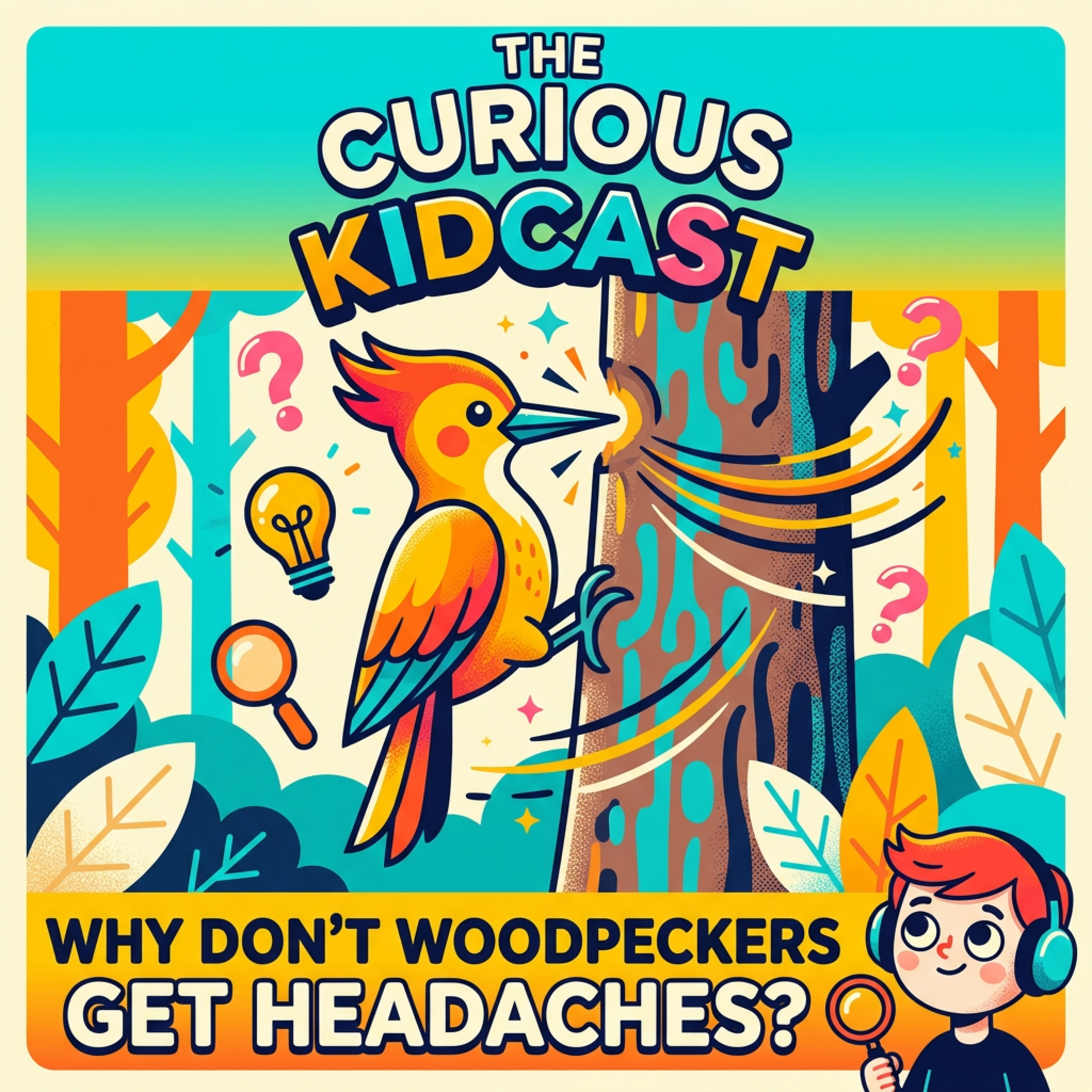
Why Don't Woodpeckers Get Headaches?
Listen to this episode
What You'll Learn
- Why woodpeckers can peck tree trunks thousands of times without damaging their brains.
- How a woodpecker’s skull helps absorb powerful impacts.
- Why the shape of the beak helps direct force away from the brain.
- How the brain fits inside the skull in a way that reduces movement and injury.
- How soft tissues and bone structures act like natural shock absorbers.
- Why strong neck muscles help power and control each peck.
- How a woodpecker’s extraordinary tongue is adapted for feeding and protection.
- How special eyelids help protect the eyes during pecking.
- Why grippy feet and a stiff tail help keep the bird stable on a tree trunk.
- How scientists study animals to inspire human inventions through biomimicry.
- Woodpeckers can peck at wood incredibly fast and repeat the movement many times a day.
- Their bodies are specially adapted to deal with repeated force and impact.
- Different parts of the head, neck, beak, and body work together to reduce injury.
- Biomimicry means copying ideas from nature to solve human problems.
Show Notes
The Curious Kidcast is a fun podcast for kids who love big questions, amazing facts, science, nature, animals, and learning how the world works. In this episode, Charlie explores one of the most surprising bird questions in nature: why do woodpeckers not get headaches? It is a brilliant science adventure packed with animal facts, biology, adaptation, and the incredible body features that help woodpeckers peck tree trunks again and again without getting hurt.
If you are looking for kids curiosity podcasts, a fun podcast for kids, or a science podcast for kids that mixes real facts with family-friendly learning, this episode is packed with discovery. It is ideal for curious kids aged 7 to 12, as well as parents, teachers, and homeschoolers who want educational audio that helps children learn, laugh, and stay curious.
What kids will learn in this episode
- Why woodpeckers can peck tree trunks thousands of times without damaging their brains.
- How a woodpecker’s skull helps absorb powerful impacts.
- Why the shape of the beak helps direct force away from the brain.
- How the brain fits inside the skull in a way that reduces movement and injury.
- How soft tissues and bone structures act like natural shock absorbers.
- Why strong neck muscles help power and control each peck.
- How a woodpecker’s extraordinary tongue is adapted for feeding and protection.
- How special eyelids help protect the eyes during pecking.
- Why grippy feet and a stiff tail help keep the bird stable on a tree trunk.
- How scientists study animals to inspire human inventions through biomimicry.
Fun animal and science facts for curious kids
- Woodpeckers can peck at wood incredibly fast and repeat the movement many times a day.
- Their bodies are specially adapted to deal with repeated force and impact.
- Different parts of the head, neck, beak, and body work together to reduce injury.
- Biomimicry means copying ideas from nature to solve human problems.
- Scientists have used lessons from woodpeckers to think about safer helmets and protective sports equipment.
Perfect for families and homeschooling
This episode links well with KS2 science topics including animals, habitats, adaptation, forces, movement, and how living things are suited to their environment. It is perfect for family listening, classroom use, home education, and homeschooling, helping children learn real science facts in a fun, memorable, and engaging way.
Whether you are listening in the car, during a homeschool science session, on a nature walk, or as part of a family learning routine, this episode makes biology exciting and easy to understand. It is a great choice for children who love birds, wildlife, nature, fun facts, and asking curious questions about animals.
Why families love The Curious Kidcast
The Curious Kidcast turns curious kids questions into fun science and nature adventures for young listeners. Each episode explores animals, space, weather, the human body, nature, and everyday mysteries with humour, storytelling, and amazing facts. It is a great choice for curious children, parents, teachers, and homeschool families looking for a fun way to learn together.
About The Curious Kidcast
The Curious Kidcast is a family-friendly educational podcast for kids aged 7 to 12. Each episode answers curious kids questions with fun storytelling, humour, and facts that help children understand science and the world around them. It is perfect for families who want fun learning, real science, and a podcast kids genuinely enjoy.
Send your question at curiouskidcast.com.
Keywords: why do woodpeckers not get headaches, woodpecker facts for kids, bird facts for kids, animal adaptations for kids, biomimicry for children, science podcast for kids, curious kids questions, fun podcast for kids, kids curiosity podcasts, nature podcast for kids, homeschool science, family podcast, biology for kids, wildlife facts for children, educational podcast for kids, The Curious Kidcast